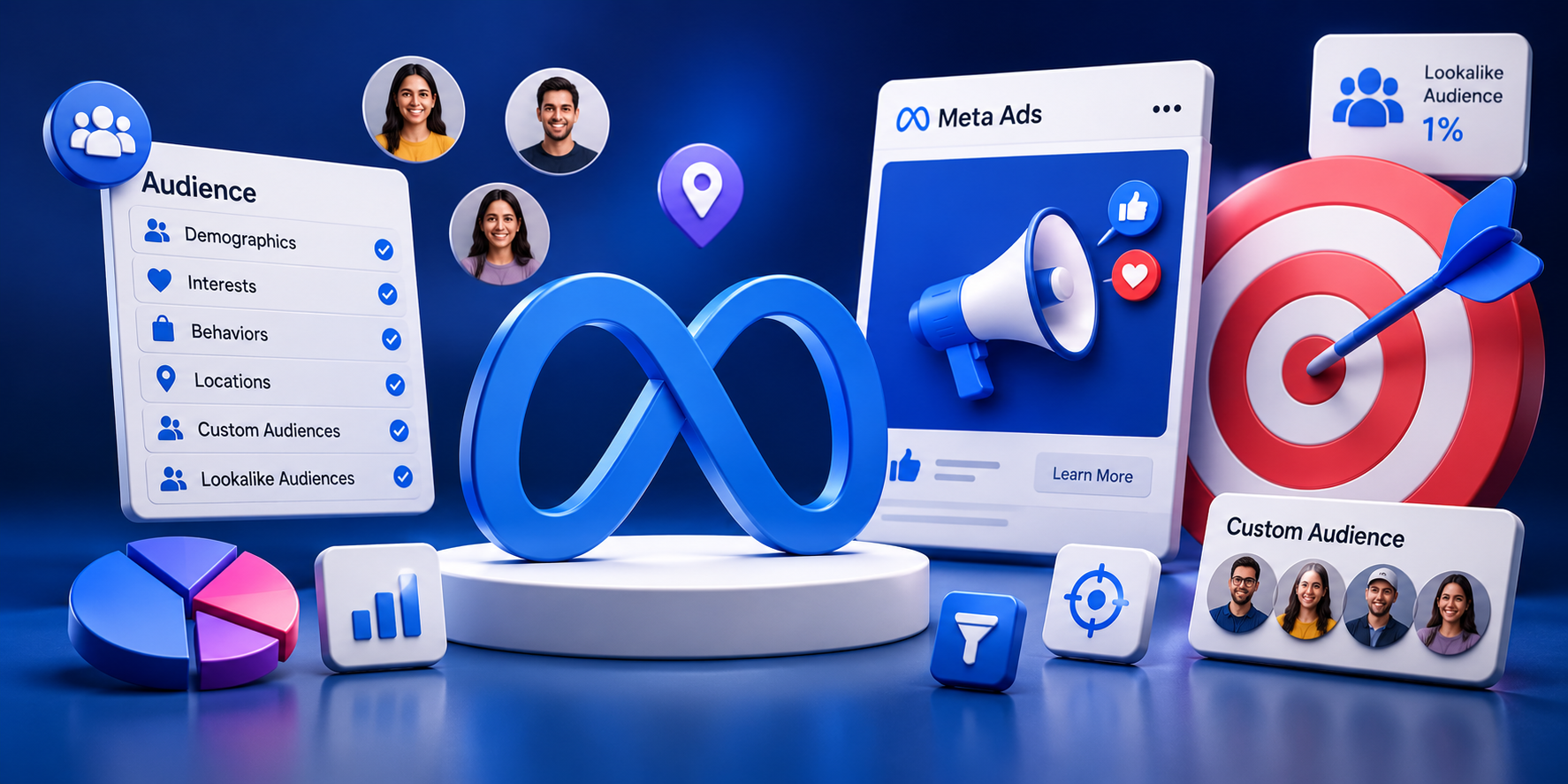
If you have spent any time running Meta Ads, you already know the platform can either be your most profitable marketing channel or a fast way to burn through budget with very little to show for it. The difference almost always comes down to one thing: targeting.
Getting your ad in front of the right person at the right moment is the entire game. Your creative can be brilliant, your offer can be irresistible, but if the wrong people are seeing it, you are paying for noise.
Here are ten Meta Ads targeting strategies that experienced media buyers actually use — not theoretical advice, but approaches that move the needle on real campaigns.
1. Start Broad and Let the Algorithm Do Its Job
This feels counterintuitive, especially when you are new to paid advertising. Most people assume more targeting equals better results. In reality, Meta’s algorithm has become extraordinarily good at finding buyers inside large audiences — often better than any interest or behavior you could manually select.
Starting with a broad audience — minimal interest targeting, correct age range, relevant countries — and letting Meta’s machine learning optimize toward purchase events consistently outperforms heavily stacked targeting in most verticals today.
The key condition here is data. This approach works when your pixel has enough purchase events to learn from. If your pixel is fresh, you need to feed it first with lower-funnel events like Add to Cart or Initiate Checkout before asking it to find buyers.
Who this works for: Ecommerce brands with an active pixel, advertisers running Advantage+ Shopping Campaigns.
2. Advantage+ Audience — Use It, But Set Your Suggestions
Meta’s Advantage+ Audience is worth testing on most campaigns. It removes manual audience selection entirely and lets the system find its own buyers based on creative signals and conversion data.
What many advertisers miss is the “Audience Suggestions” section inside Advantage+ setup. Here you can add interest-based or demographic inputs as suggestions — not hard restrictions. The algorithm will start within your suggested parameters but will expand beyond them if it finds better results elsewhere.
This gives you the best of both worlds: algorithmic freedom with a directional nudge from your knowledge of your customer.
3. Lookalike Audiences Built from Your Best Customers
Lookalike Audiences remain one of the most powerful targeting tools Meta offers — but only when you seed them correctly.
Most advertisers create Lookalikes from their entire customer list or from all website visitors. A better approach is to segment your source audience before building the Lookalike. Create a Lookalike based only on your highest-value customers — those who have spent above a certain threshold, repeat purchasers, or customers with the highest lifetime value.
A 1% Lookalike of your top 500 customers will outperform a 1% Lookalike of all 10,000 people who visited your website in the last 180 days. The quality of the seed determines the quality of the audience.
Pro tip: Upload your customer list as a Custom Audience, then create the Lookalike directly from that list rather than from a pixel event for maximum data match rate.
4. Interest Stacking vs Interest Expansion — Know the Difference
Interest targeting gets misused more than almost any other feature in Meta Ads Manager. There are two distinct approaches and they serve very different purposes.
Interest Stacking means putting multiple interests into the same ad set, narrowing your audience to people who match at least one of those interests. Use this when you want to build a focused audience around a clear category — for example, targeting people interested in yoga, meditation, and wellness for a fitness product.
Narrow by (intersection targeting) means your audience must match Interest A AND Interest B. This dramatically reduces audience size but increases relevance. Use this sparingly, and only when the overlap genuinely makes sense — for example, “small business owners” AND “digital marketing.”
Confusing these two approaches is one of the most common and costly mistakes in Meta Ads targeting.
5. Retargeting Stack — Hit the Right Window at the Right Time
Retargeting is not a single audience. It is a stack of audiences at different stages of intent, and each one needs a different message.
Structure your retargeting like this:
- Video viewers (75%+) — They know you exist. Run testimonials or social proof content.
- Website visitors (last 30 days) — They showed interest. Run benefit-focused ads or urgency offers.
- Add to Cart / Initiate Checkout (last 14 days) — They were close. Run strong offers or overcome objections.
- Past purchasers (30-90 days) — They trust you. Run upsell or complementary product campaigns.
Each audience gets a message calibrated to where they are in the buyer journey. Running the same ad to all four groups is one of the fastest ways to waste retargeting budget.
6. Custom Audiences from Customer Lists — Upload Regularly
Your CRM is one of your most valuable assets inside Meta Ads. Uploading your customer email list as a Custom Audience allows you to run ads directly to people who have already purchased from you — or to exclude them from prospecting campaigns to avoid wasted spend.
Upload frequency matters. Most advertisers upload their list once and leave it. A better practice is refreshing your custom audience every 30 days, especially if you have an active customer base. New purchasers get added, churned customers fall off, and your audience stays current.
Also use your customer list to suppress buyers from acquisition campaigns. There is no point paying Meta to show acquisition ads to people who are already your customers.
7. Engagement Custom Audiences — Capture Warm Traffic from Every Source
Not everyone who is interested in your product visits your website. Many people engage with your Instagram content, watch your videos, fill out a lead form, or interact with your Facebook Page without ever clicking through.
These people are warm. They are not strangers, but they are not captured in your pixel data. Engagement Custom Audiences let you target them directly.
Build audiences from:
- Instagram profile engagers (last 30, 60, 90 days)
- Facebook Page engagers
- Video viewers (25%, 50%, 75%, 95% completion)
- Lead form openers (even if they did not submit)
These audiences often convert at rates close to your website visitor retargeting — at a fraction of the CPM.
8. Layered Demographic Targeting for High-Ticket Offers
For high-ticket products or services — anything above ₹10,000 or $200 — demographic layering can meaningfully improve your campaign economics by excluding audiences who are statistically unlikely to convert at that price point.
Consider layering in:
- Income targeting (available in select countries): Target the top 10-25% of household incomes
- Life events: Recently moved, newly engaged, new job — depending on your product
- Behaviors: Frequent international travelers, online buyers with premium purchase history
This does not mean dramatically shrinking your audience. It means applying intelligent filters that shift your budget toward the demographic segments most likely to have both the intent and the ability to buy.
9. Exclusion Audiences — The Targeting Strategy Nobody Talks About
What you exclude from your audience is just as important as what you include. Experienced media buyers spend as much time on exclusions as they do on targeting.
Standard exclusions to set up immediately:
- Exclude recent purchasers from prospecting campaigns (last 30-60 days)
- Exclude your email list from cold prospecting
- Exclude people who have already seen your retargeting ads 10+ times (frequency cap via exclusion)
- Exclude audiences that have already converted from lead gen campaigns
Exclusions reduce wasted spend, improve your Cost Per Result, and ensure your ads feel relevant rather than repetitive to the people who are seeing them.
10. Creative-Led Targeting — Let Your Ad Find Its Own Audience
This is the most advanced strategy on this list, and it is the one that separates average media buyers from great ones.
In Meta’s current algorithmic environment, your creative is your targeting. The visual style, the language, the hook, the pain points you reference — all of these signal to Meta’s system exactly who should see your ad. When your creative speaks directly to a very specific type of person, Meta finds that person.
A video ad that opens with “Struggling to scale your Shopify store past seven figures?” will find Shopify store owners. An ad that says “For busy moms who have no time to meal prep” will find that exact demographic — with no interest targeting required.
Write your hooks for your ideal customer, not for the general population. The algorithm will do the rest.
The One Thing Most Advertisers Get Wrong
Most Meta Ads failures come down to testing too many things at once — changing the audience, the creative, the offer, and the copy simultaneously and having no idea what actually caused a result to improve or decline.
Test one variable at a time. Lock your audience and test creatives. Lock your creative and test audiences. Lock both and test offers. Build a systematic testing framework and you will learn faster than any amount of budget alone can teach you.
At The Brand Hawk, this is the methodology we apply to every campaign we run. Systematic. Data-driven. No guesswork.
Final Thought
Meta Ads targeting has changed significantly over the last few years. The platform has shifted toward algorithmic optimization, which means manual targeting is less about dictating who sees your ads and more about giving the machine the best possible inputs to learn from.
The brands winning on Meta right now are not the ones with the most complex targeting setups. They are the ones with the best creative, the cleanest data, and the patience to let the algorithm learn before making changes.
Start with broad audiences, build quality retargeting stacks, upload your customer data regularly, and let your creative do the heavy lifting.