If you have ever sat in front of your ad manager wondering whether to run your next campaign on Facebook or Instagram, you are not alone. It is one of the most common questions brands ask before they spend a single rupee — or dollar — on paid social.
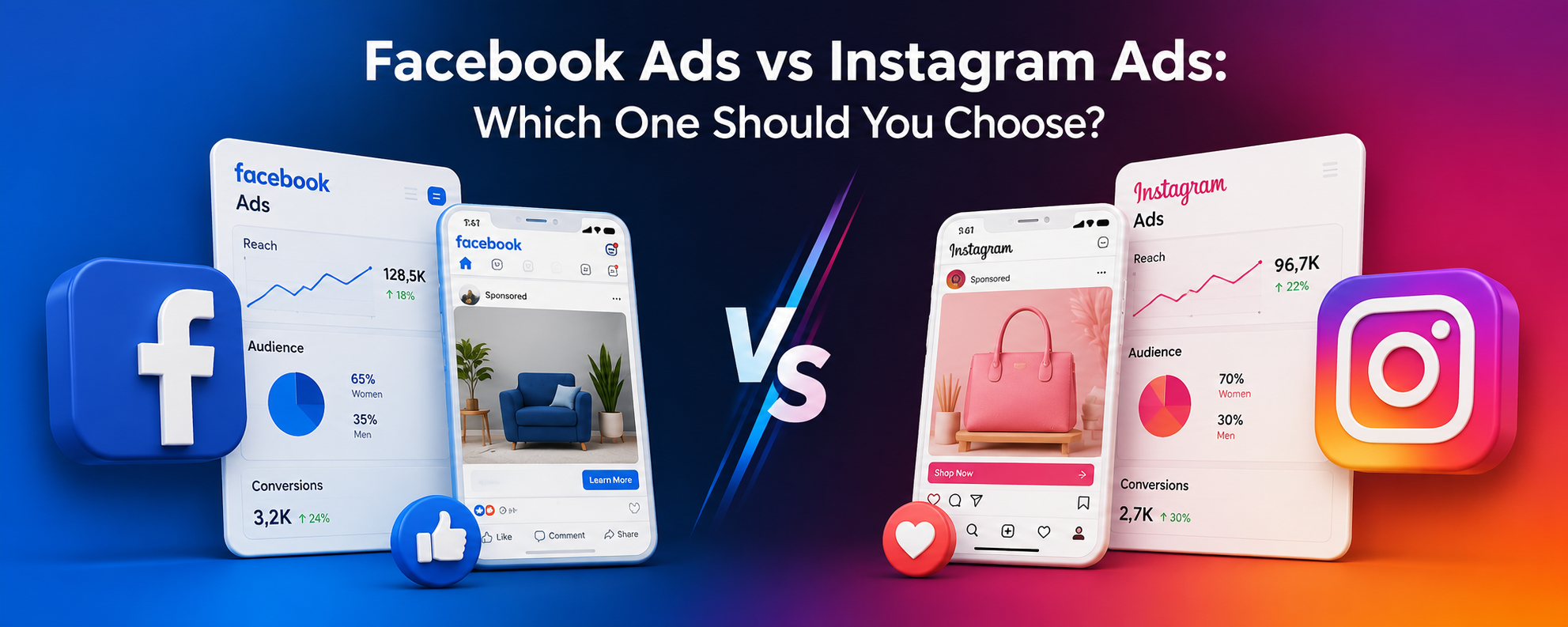
The truth is, there is no universal answer. Both platforms sit inside the same Meta ecosystem, share the same ad infrastructure, and can even run campaigns simultaneously. But the audiences, the content formats, the intent behind the scroll, and the results you can realistically expect are very different.
Let us break it down properly so you can make a confident call.
Understanding the Fundamental Difference
Facebook has been around since 2004. It has a broad, mature user base — people in their thirties, forties, and beyond who use the platform to read news, join groups, follow pages, and engage with longer-form content. The intent on Facebook is often more deliberate. People are looking for information, community, and connection.
Instagram, launched in 2010 and acquired by Meta in 2012, is built around visuals. Short videos, aesthetic photography, Stories, and Reels dominate the experience. The audience skews younger — primarily 18 to 34 year olds — and the platform rewards brands that can communicate their value instantly, in the first two seconds of a scroll.
| Founded | 2004 | 2010 (acquired by Meta 2012) |
| Primary Age Group | 35+ years | 18–34 years |
| Content Type | Text, links, news, groups | Visuals, Reels, Stories, photos |
| User Intent | Information & community | Discovery & inspiration |
| Best For | B2B, high-ticket, older audience | Ecommerce, lifestyle, visual products |
The Audience Breakdown
Facebook attracts a wider demographic spread. You will find users across every age group, but the platform is particularly strong for reaching people aged 35 and above. It is the go-to platform for community-driven content, local business discovery, event promotion, and B2B-adjacent targeting.
Instagram skews significantly younger. If your product or service appeals to millennials and Gen Z — fashion, fitness, food, beauty, travel, lifestyle — Instagram is where your audience is actively spending time and, crucially, discovering new brands through content that genuinely inspires them.
If you are selling high-ticket B2B software, Facebook likely has your audience. If you are selling skincare, streetwear, or anything that photographs beautifully, Instagram should be your primary focus.
Creative Format — What Works Where
This is where the strategic differences really show up.
On Facebook, longer copy tends to perform better. Users are more willing to read a detailed post, click through to a blog article, or engage with a carousel that walks them through multiple benefits. Text-heavy ads, link posts, and lead generation forms convert well here because the audience has the patience and the context to process information before deciding.
On Instagram, you have about two seconds to stop the scroll. Your creative needs to land visually before a single word is read. High-quality imagery, short punchy captions, and Reels that hook in the first frame consistently outperform anything that relies on text to carry the message. Instagram rewards brands that invest in their visual identity.
The practical takeaway? If your creative is video or visually stunning, start with Instagram. If your offer requires explanation, context, or longer copy to convert, lean toward Facebook.
Cost and Competition
Generally speaking, Facebook tends to have a lower average Cost Per Click (CPC) across many industries because inventory is broader and competition for certain demographics is lower. For brands targeting older audiences or niche interest groups, Facebook can be incredibly cost-efficient.
Instagram can run slightly more expensive on a CPC basis in competitive verticals — particularly fashion, beauty, and fitness — because the audience is desirable and brands compete aggressively for the same eyeballs. However, the engagement rates on Instagram are typically higher, which means your cost per genuine interaction is often comparable or better.
Neither platform is inherently cheaper. Your product, audience, and creative quality will ultimately determine your actual costs.
| Cost Metric | ||
| Average CPC | Generally lower | Slightly higher in competitive niches |
| Engagement Rate | Lower | Higher |
| CPM (Cost per 1000 impressions) | Comparable | Comparable |
| Best Budget Efficiency | Older audiences, B2B | 18-34, ecommerce, lifestyle |
Purchase Intent and the Buyer Journey
Facebook users often discover your ad while doing something else entirely — reading a news article, checking a group, or browsing their feed. The purchase intent at that moment is relatively low, which means your ads need to build desire first and convert second.
Instagram users, particularly those browsing the Explore page or watching Reels, are in a much more receptive mindset for product discovery. Impulse purchases are more common on Instagram — especially for direct-to-consumer brands with strong visual products. The scroll-to-purchase journey can be remarkably short when your creative lands well.
Which Platform Wins for Your Business?
Here is a simple framework to guide your decision:
Choose Facebook if:
- Your audience is primarily 35 years and older
- Your product or service requires explanation before purchase
- You are running lead generation campaigns for B2B or high-ticket offers
- You want to leverage community groups or event-based marketing
- Your budget is limited and you need broad reach at a lower CPC
Choose Instagram if:
- Your audience is 18 to 34 years old
- Your product has strong visual appeal — fashion, beauty, food, fitness, travel
- You are running ecommerce campaigns with a short decision cycle
- You have strong video creative or Reels-ready content
- Brand aesthetics and identity are central to your marketing strategy
Run both if:
- You have the budget to test across placements
- You sell products that appeal to a wide age range
- You want to build a full-funnel campaign — awareness on Instagram, retargeting on Facebook
The Smart Move — Let the Data Decide
Here is something experienced media buyers know that beginners often miss: Meta’s algorithm is smarter than any assumption you make before launch.
When you set up a campaign inside Meta Ads Manager, you have the option to run placements across both Facebook and Instagram simultaneously using Advantage+ Placements. In most cases, especially early in a campaign’s life, this is the right move. Let the algorithm spend across both platforms and find where your specific audience is most likely to convert.
After a few days of data, you will have real numbers — actual Cost Per Purchase, Return on Ad Spend, and Click Through Rate broken down by placement. At that point, you can make an informed decision about where to concentrate your budget, rather than relying on assumptions.
| At The Brand Hawk, this is exactly how we approach new campaigns. We test broadly, read the data honestly, and then make deliberate scaling decisions based on what the numbers are actually telling us — not what we assumed at the start.
Want a team that does this for your brand? Book a free strategy call and let’s talk about your Meta Ads setup. |
Final Thought
Facebook and Instagram are not rivals. They are two complementary tools inside the same ecosystem, each with a distinct strength depending on your audience, your creative, and your offer.
If you are still unsure which platform is right for your specific business, the most expensive mistake you can make is to delay testing entirely. Start with a modest budget, run placements on both, and let the data show you where your audience actually lives.
And if you want a team that has done this across dozens of brands and knows how to read that data fast — that is exactly what The Brand Hawk is here for.