Picking a Meta Ads agency for a D2C brand isn’t the same as picking one for a local business or a B2B company. D2C brands live and die by ROAS, repeat purchase rate, and how fast they can turn a new creative into profitable spend. Get the wrong partner and you’ll burn a quarter’s worth of budget finding that out the hard way.
This guide is built around one question: how do you actually tell a good D2C-focused Meta Ads agency from one that’s just going to run generic campaigns and call it strategy? Below is the checklist, the red flags, and the questions worth asking before you sign anything.
Why D2C Brands Need a Different Kind of Meta Ads Partner
A D2C brand isn’t selling a one-time service or a B2B contract — it’s selling a product that needs to be discovered, trusted, and repurchased, often within a tight margin. That changes what good Meta Ads management looks like.
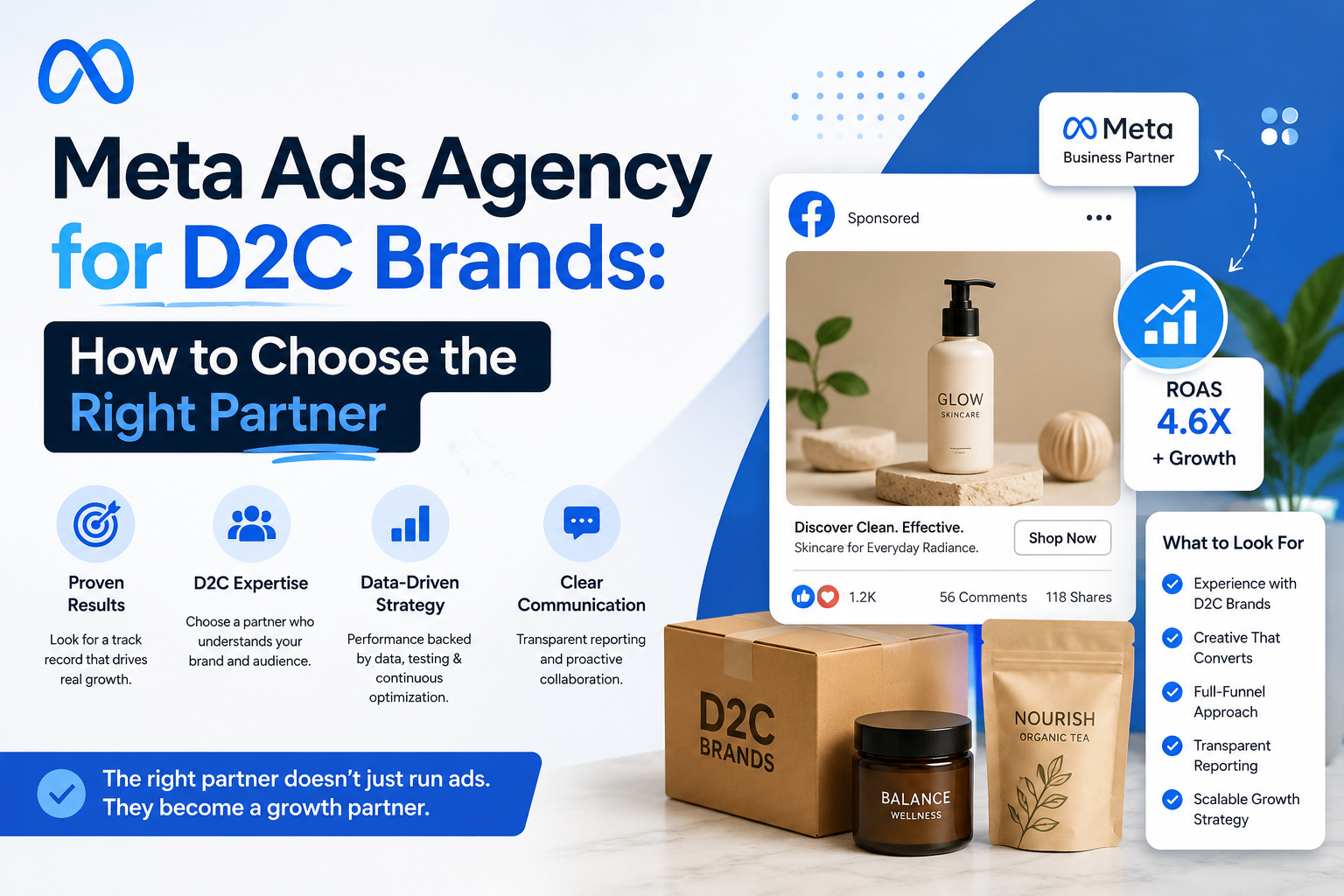
A D2C-focused agency thinks about creative testing volume, contribution margin (not just ROAS), retention and repeat-purchase campaigns, and how Meta Ads fits alongside other channels like Google Ads or TikTok Ads. A generalist agency, on the other hand, tends to treat every client the same — same reporting template, same campaign structure, regardless of whether you’re selling skincare or software.
The Real Checklist: What to Ask Before You Sign
1. Show me D2C accounts you currently manage.
Not case studies from two years ago — current accounts, ideally in a similar price point or purchase frequency to your product. An agency that mostly serves service businesses or SaaS clients will structure your account the same way they structure everyone else’s, which doesn’t map well to D2C buying behaviour.
2. How many new creatives do you test per month?
Creative fatigue happens faster in D2C than almost any other category, because the same audience sees your ads repeatedly. A serious agency should have a concrete number here — weekly or biweekly creative batches, not just refreshing creative once performance already drops.
3. Walk me through your reporting
Ask them to show a real (anonymised) client report. You’re looking for ROAS, CAC, contribution margin, and creative-level breakdowns — not just a screenshot of the Meta Ads Manager dashboard with commentary bolted on.
4. What happens to my account if my main point of contact leaves?
Agencies grow and people move around. You want a partner where account knowledge lives in documented strategy and shared reporting, not in one person’s head.
5. How do you handle tracking after iOS privacy changes?
If they don’t immediately mention Conversions API or server-side tracking, that’s a gap. Weak tracking means Meta’s algorithm is optimising on incomplete data, which quietly caps your ROAS ceiling.
6. What’s included beyond media buying?
Some agencies stop at campaign management. Others fold in social media marketing, landing page work, or even website development when a slow site is capping conversion rate. Knowing where their scope ends matters, especially if your website is part of the problem.
Red Flags to Watch For
- Guaranteed ROAS numbers before they’ve even seen your account — nobody can promise a specific return before reviewing historical data and creative quality.
- Long lock-in contracts with no performance review clause — a confident agency doesn’t need to trap you in a 12-month contract to prove results.
- Vague answers about tracking — if they can’t clearly explain how they’re solving for iOS14+ data loss, your reporting will be unreliable from day one.
- No creative process — if creative direction is just send us your product photos and we’ll handle it, expect generic ads that blend into the feed.
- One-size-fits-all packages — D2C brands at different revenue stages need different funnel structures; a flat package price with no customisation is a sign of a volume-focused agency, not a growth partner.
Understanding Pricing Models
Most agencies price one of two ways: a flat monthly retainer, or a percentage of ad spend (commonly 10-20%). Retainers tend to work better once you’re spending a meaningful monthly budget, since a percentage fee stops making sense at scale. Percentage-of-spend can work well for smaller or newer brands where the agency’s incentives stay tied to growing your budget responsibly. Either way, ask what’s included — media buying only, or media buying plus creative, reporting, and strategy calls.
What Working with The Brand Hawk Looks Like
At The Brand Hawk, D2C and ecommerce brands aren’t a side vertical — they’re who we build our entire Meta Ads process around. Every account starts with a review of your current funnel, tracking setup, and past creative performance before we touch a single campaign, so the strategy is built on your actual numbers instead of a generic template.
We also run Google Ads, TikTok Ads, LinkedIn Ads, AI video creative, website development, and JioHotstar/OTT advertising — so if the honest answer is that your site needs fixing before your ad spend can convert properly, we can say that upfront instead of just pushing more budget into Meta.
You can see more about how we work on the About Us page, or browse the full service list at thebrandhawk.com.
Frequently Asked Questions
How do I know if my Meta Ads agency is actually good, a few months in?
Look past the top-line ROAS number. Ask for creative-level performance, whether new tests are being launched regularly, and whether your CAC trend is improving month over month, not just staying flat.
Should a D2C brand work with a specialised agency or a full-service one?
Specialised agencies usually go deeper on Meta-specific strategy, while full-service agencies can be useful if you also need website, creative, and multi-channel work under one roof. The right choice depends on how much you’re already managing in-house.
How long should I give a new Meta Ads agency before judging results?
Give it at least 60-90 days. The first few weeks are testing, and Meta’s algorithm needs consistent conversion data before performance stabilises. Judging an agency at the two-week mark almost never gives an accurate picture.
What’s a reasonable ad budget to start with for a D2C brand?
It depends on your average order value and margins, but most agencies recommend enough monthly budget to generate at least 30-50 conversions, since that’s roughly what Meta’s algorithm needs to exit the learning phase and optimise properly.