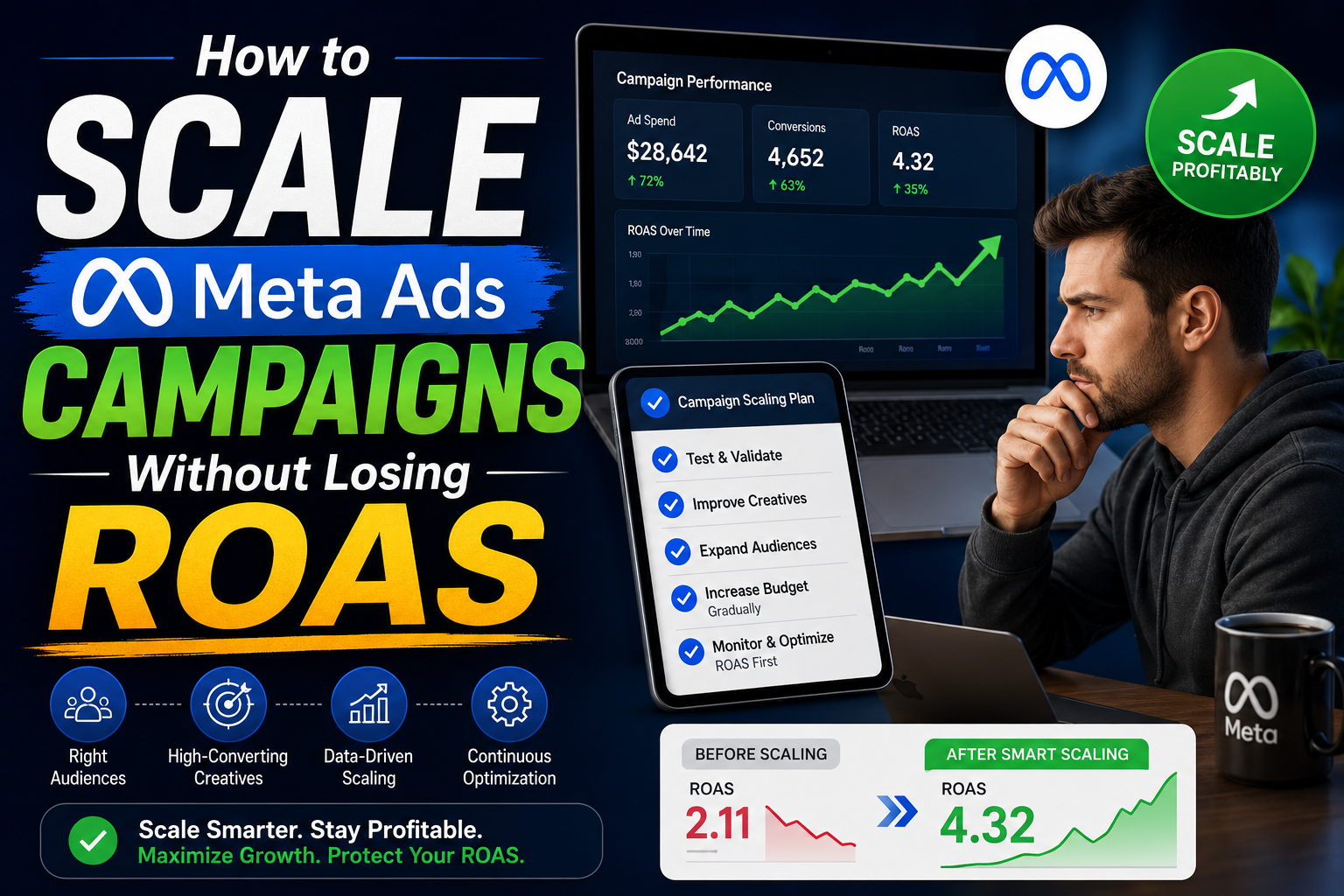
Scaling a winning Meta Ads campaign sounds simple — increase the budget, watch the sales grow. In reality, most brands see the opposite: the moment they push spend up, ROAS drops, cost per result climbs, and a campaign that looked profitable suddenly doesn’t. The problem usually isn’t the platform — it’s how the scale-up is done.
Done right, scaling is predictable. Here’s the framework we use to grow ad spend without watching efficiency fall apart.
1. Scale Budget, Not Just Spend
Increasing daily budget by 50-100% overnight forces Meta back into a mini learning phase, which is exactly when performance dips. The algorithm has to re-learn who converts at the new spend level, and that re-learning period is where ROAS usually takes the hit.
What works instead: Increase budgets in steps of 15-20% every 2-3 days rather than in one large jump. This keeps the algorithm inside its existing learning curve instead of resetting it, and gives you a clean read on whether the extra spend is actually converting.
2. Scale Horizontally, Not Just Vertically
Pushing all new budget into one ad set eventually hits a ceiling — audience saturation sets in, frequency rises, and cost per result climbs even if the daily budget increase was gradual. Vertical scaling alone almost always runs out of room faster than expected.
What works instead: Duplicate winning ad sets into new campaigns targeting adjacent audiences — lookalikes at different percentages, related interests, or broad targeting fed by a strong pixel. Horizontal scaling spreads the extra spend across fresh inventory instead of forcing more out of an audience that’s already been served the ad repeatedly.
3. Feed the Algorithm New Creative Before It Asks
Creative fatigue accelerates as spend increases, simply because more people see the same ad, faster. A creative that performed well at a lower budget can burn out within days once frequency climbs from scaled spend.
What works instead: Have 2-3 new creative variants ready before scaling, not after performance drops. Agencies running meta ads management services for scaling accounts typically launch new creative on a rolling schedule tied to spend increases, not just a fixed weekly calendar.
4. Protect the Middle of the Funnel
It’s tempting to put every extra rupee or dollar into cold prospecting once a campaign is working, but that ignores the retargeting and warm audiences that convert at a much lower cost. As cold spend increases without matching retargeting budget, blended ROAS drifts down even though the top-of-funnel numbers look fine.
What works instead: Scale retargeting and warm-audience budgets in proportion to prospecting, not as an afterthought. A funnel that stays balanced as it grows protects overall account ROAS far better than a prospecting-only scale-up.
5. Watch Frequency and CPM as Leading Indicators
By the time ROAS visibly drops, the underlying problem — usually rising frequency or CPM — has often been building for days. Waiting for the ROAS number to move before reacting means losing budget on inefficiency that could have been caught earlier.
What works instead: Track frequency and CPM daily during any scale-up. A frequency climbing past 3-4 within a short window, or CPM rising faster than conversion rate, is an early signal to refresh creative or expand audience before ROAS actually falls.
6. Use Campaign Budget Optimization (CBO) Deliberately
CBO can be a powerful scaling tool, automatically shifting budget to the best-performing ad sets. But left unchecked, it can also starve newer ad sets of the data they need to prove themselves, quietly narrowing your account down to just one or two ad sets over time.
What works instead: Use CBO with ad set minimum spend limits when testing new audiences alongside scaled winners, so promising new ad sets get a fair chance to gather data instead of being starved by an already-proven top performer.
7. Don’t Scale Everything at Once
Scaling budget, launching new creative, expanding audiences, and testing a new campaign objective all in the same week makes it almost impossible to know which change actually affected ROAS when performance shifts.
What works instead: Change one major variable at a time — budget, creative, or audience — so any drop or gain in ROAS can be traced back to a clear cause, not guessed at.
The Bottom Line
Scaling Meta Ads without losing ROAS isn’t about a single trick — it’s about pacing budget increases, spreading growth across fresh audiences, keeping creative ahead of fatigue, and protecting the parts of the funnel that already convert well. Brands that scale gradually and deliberately consistently outperform those that chase growth by simply raising the daily budget.
If you’re sitting on a Meta Ads account that performs well at a small budget but struggles the moment you try to grow it, that’s usually a scaling process problem, not a platform problem — and it’s fixable.
Want to scale profitably? Talk to our meta ads specialistsand get a free scaling audit of your current Meta Ads account.