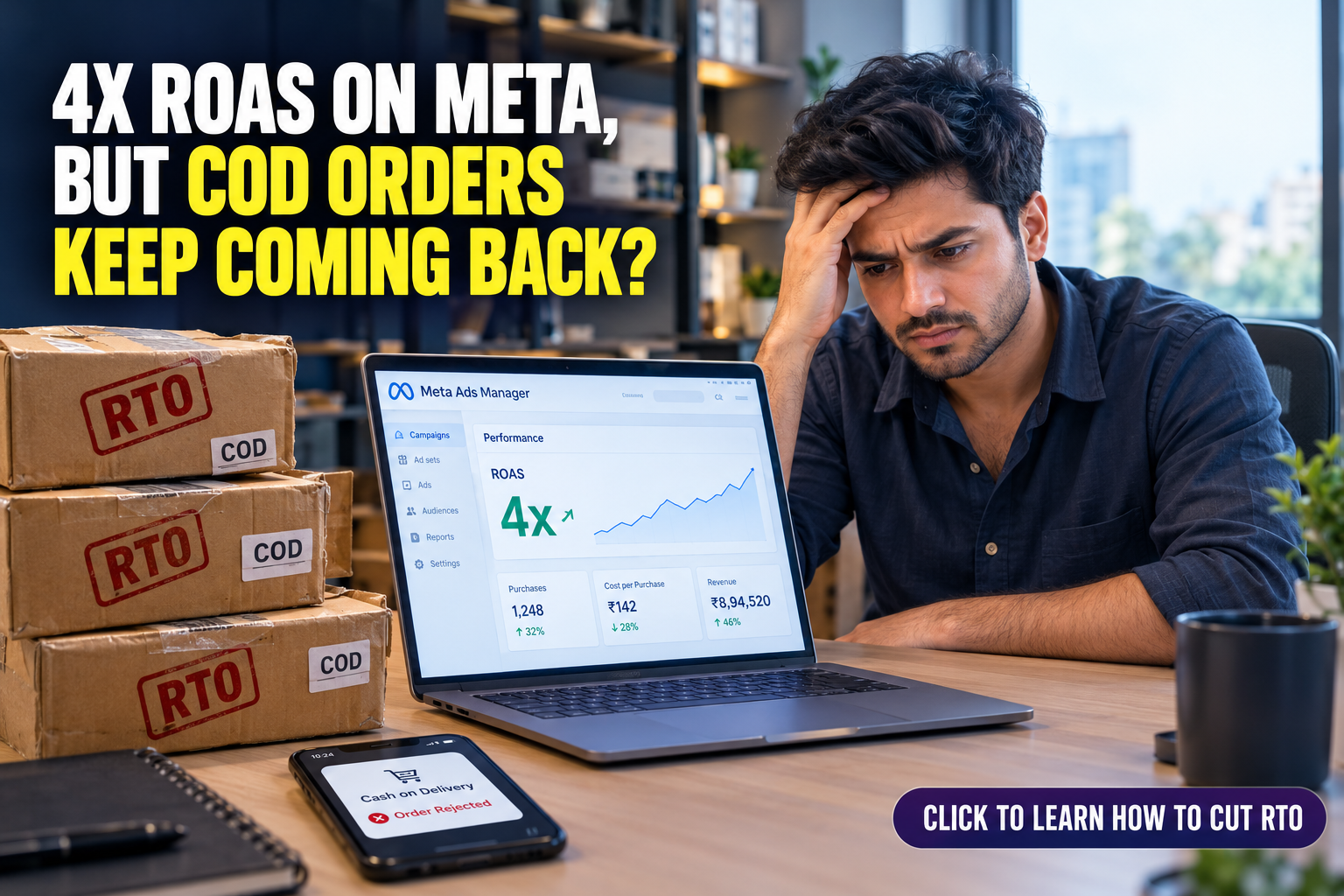
Your Meta ads dashboard says 4x ROAS. Your bank account says something very different. If you sell in India, you already know why: cash on delivery orders that never get accepted.
RTO (return to origin) quietly eats D2C margins. You pay for the ad, the packaging, shipping both ways and the time your team spent. Meta counts the sale. You lose money on it.
The good news: a lot of RTO is created by how you advertise, and you can fix that part.
Why Meta ads can increase RTO
Meta optimises for the Purchase event. A COD order fires that event exactly like a prepaid order. So if COD buyers are easier to get, Meta will happily find you more of them, including people who order on impulse and refuse the parcel later.
The ad itself can make this worse. Very aggressive discounts, “limited stock” pressure and vague product photos attract people who are curious, not committed.
Step 1: Measure your real ROAS
Before changing anything, calculate delivered ROAS, not reported ROAS.
Delivered ROAS = revenue from delivered orders ÷ ad spend
If Meta shows 4x but 35% of COD orders return, your real number is much lower. Make this your main metric for the next month. It changes how you judge every ad.
Step 2: Find which ads bring the worst RTO
Use UTM tags on every ad (Shopify and most Indian logistics dashboards can read them). After two weeks, compare RTO by campaign and by creative.
Patterns we commonly see:
- Ads with huge discount callouts bring more RTO than ads about the product itself
- Ads aimed at Tier 3 towns with long delivery times bring more RTO
- Late night impulse buyers cancel more often
- Very low priced products have higher RTO because buyers feel nothing is at stake
Your data may show different patterns. That is the point of checking.
Step 3: Change the creative, not only the targeting
The fastest fix is honest creative. Show real size, real fabric, real colour in daylight. Show how the product looks on a normal person, not only a model. When the parcel matches the ad, fewer people refuse it.
Try these angles:
- A try on video with size details on screen
- A customer review clip that mentions delivery and quality
- A clear line about your exchange policy, so people do not fear being stuck
Step 4: Nudge people towards prepaid
You do not have to remove COD. You can make prepaid the obvious choice.
- Offer a small prepaid discount or free shipping only on prepaid
- Add a small COD handling fee on low value orders
- Mention “extra ₹50 off on UPI” in the ad itself, not only at checkout
Prepaid buyers have already committed, so their delivery rate is far higher.
Step 5: Verify COD orders before shipping
A WhatsApp or IVR confirmation within an hour of the order removes many fake and impulse orders. Several Shopify apps in India do this automatically. Cancel orders that do not confirm within 24 hours.
This also improves the data you send back to Meta if you use a confirmed order or prepaid purchase as a custom event later.
Step 6: Teach Meta what a good customer looks like
Once you have a few hundred delivered orders, upload a customer list of delivered and repeat buyers and build lookalike audiences from it, or add it as an audience suggestion. You can also create a custom conversion for prepaid purchases and test optimising towards it.
This takes time but it shifts the algorithm towards buyers who actually accept parcels.
Step 7: Watch your pin codes
Your logistics partner can show RTO by pin code and city. If a few regions are consistently bad, exclude them from cold campaigns or show those areas prepaid only offers.
The trade off to accept
When you cut COD aggressively, order volume drops. That is fine if delivered revenue goes up. Judge every change by delivered orders and profit per order, not by the number Meta shows.
Frequently asked questions
What is a normal RTO rate for Indian D2C brands? It varies a lot by category, price and region. Fashion and low priced impulse products usually see higher RTO than skincare or premium products. Track your own baseline first.
Should I stop offering COD completely? For most new brands in India, no. COD builds trust. Nudge towards prepaid instead and verify COD orders.
Can I optimise Meta ads for delivered orders? Not directly, because delivery happens days later. You can get close by optimising for prepaid purchases or by using delivered customer lists for lookalikes.
Does Click to WhatsApp reduce RTO? It can, because a quick chat builds trust before the order. Read our guide on Click to WhatsApp ads for D2C brands.
Get your real ROAS checked
At The Brand Hawk we judge Meta Ads campaigns on delivered revenue, not vanity ROAS. If COD returns are eating your profit, book a free 30 minute call and we will map where the leaks are.