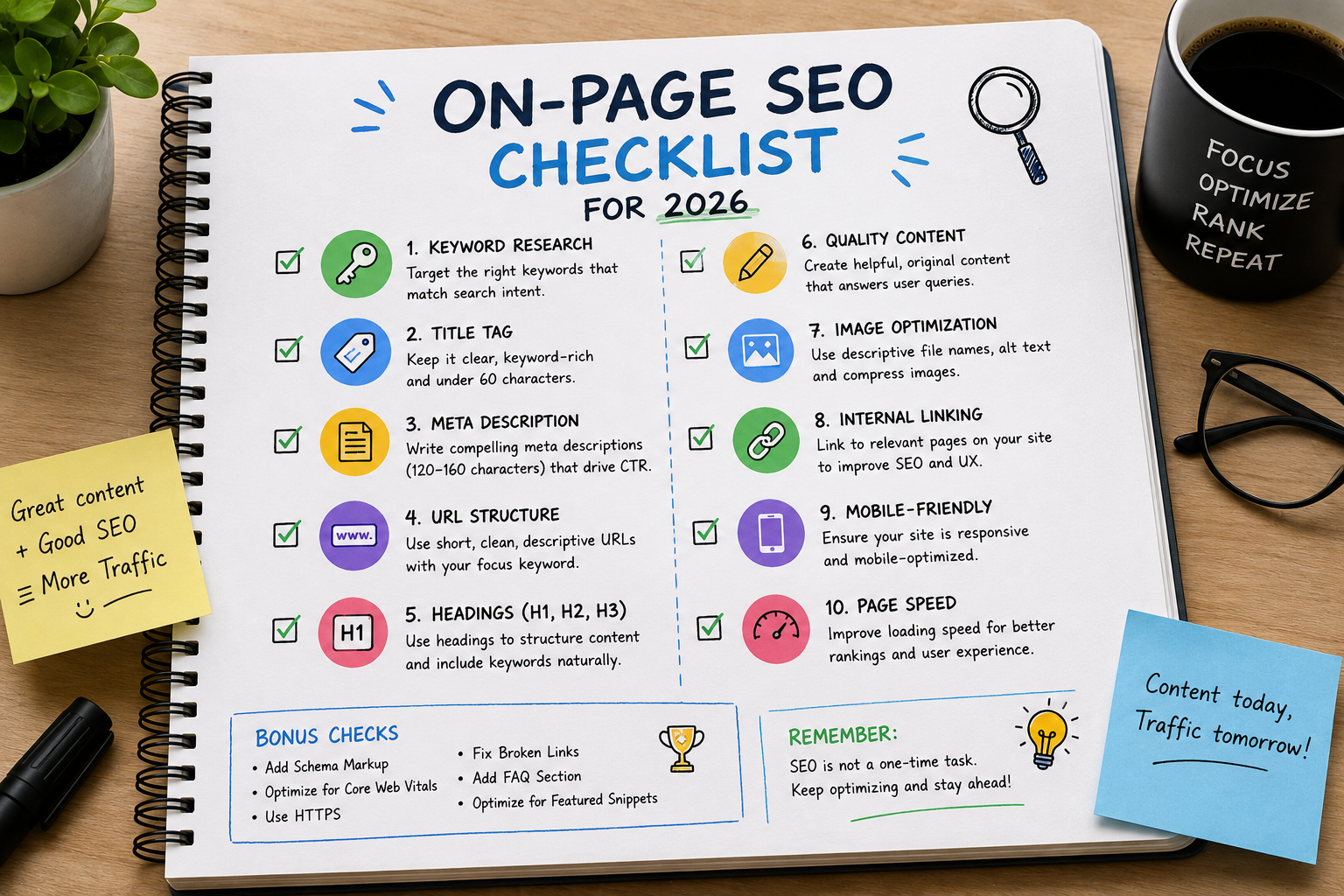
On-page SEO used to mean stuffing a keyword into a title tag and calling it done. That approach stopped working years ago, and in 2026 it’s not even close. Core on-page SEO factors now include search intent alignment, keyword placement, title tags, meta descriptions, headings, internal linking, image optimization, structured data, and page experience — and every one of them now gets evaluated by systems built to understand meaning, not just match text.
Google’s ranking systems today are layered — spam detection, relevance scoring, page experience, and quality evaluation — blended with AI models that interpret meaning and intent, which is why two pages targeting the same keyword can rank wildly differently. This checklist walks through every on-page element worth getting right, in the order that actually moves rankings.
1. Title Tags
Your title tag is still the single most important on-page element — it’s the first thing both users and Google’s algorithms read to understand what a page is about.
- Primary keyword in the first 3 words. Google weights earlier terms in the title more heavily, so front-loading your target keyword is a critical rule, not a nice-to-have.
- Keep it under ~55–60 charactersso it doesn’t truncate on mobile or desktop search results.
- Match the title to the actual page content.A misleading title drives high bounce rates, and high bounce rates drag rankings down over time.
- Add a modifier where relevant — “2026,” “Complete,” “Guide” — these consistently lift click-through rate without misrepresenting the content.
2. Meta Descriptions
Meta descriptions aren’t a direct ranking factor, but they control click-through rate, which is. Write one for every page, not just your homepage:
- Stay between 140–158 characters
- Include your primary keyword naturally — Google bolds matching terms, which draws the eye in results
- Write it like ad copy: state the specific benefit, not a vague summary
- Never duplicate meta descriptions across pages — duplicate descriptions signal a thin or templated site
3. Search Intent Match — Before Anything Else
Match search intent first, then build depth and credibility — this is the starting point for every other on-page factor, not an afterthought. Before writing or optimizing a page, check what’s actually ranking for your target keyword. If the top results are all product comparisons and your page is a how-to guide, no amount of on-page polish will overcome that mismatch.
4. Heading Structure (H1–H6)
- One H1 per page, containing the primary keyword
- H2s should break the page into logical, scannable sections — each one ideally answering a sub-question a reader (or an AI Overview) would have
- H3s nest under H2s for supporting detail — never skip levels (H2 straight to H4)
- Structure content so any individual section can stand alone— this is what lets AI systems lift a single section into an AI Overview or chat citation, rather than needing the whole page.
5. Keyword Usage — Natural, Not Forced
Use your primary keyword usage naturally in key places — but avoid forcing it into every paragraph; focus on writing naturally while keeping the topic clear, and support it with related keywords and phrases that reinforce the main topic. Keyword density as a metric is dead. What matters now is topical coverage: does the page comprehensively answer the query and its related sub-questions, in language a real person would use?
6. Content Quality and E-E-A-T
Quality content remains the single most important SEO factor — Google wants to show users high-quality, informative, and relevant content above everything else. Google prioritizes helpful, original, people-first content that demonstrates E-E-A-T (experience, expertise, authoritativeness, and trustworthiness) — without strong content, technical tweaks won’t get you far.
Practical E-E-A-T signals to build into every page:
- Author bylines with real credentials or experience relevant to the topic
- Original data, screenshots, or first-hand examples instead of recycled generalizations
- Clear sourcing and citations for any factual claims
- Regular content updates— pages that haven’t been refreshed in 12–18 months often suffer “content decay,” a gradual ranking drop as fresher competitors overtake them.
7. Internal Linking
Internal linking distributes page authority (“link equity”) and helps both users and search engines navigate your site — a good default is 3–5 internal links per 1,000 words, using descriptive, natural anchor text.
- Use descriptive anchor text.“On-page SEO checklist” tells Google far more about the linked page than “click here” does.
- Link from high-traffic pages to the pages you most want to rank— this pushes authority toward priority content.
- Fix orphan pages.Every page should be linked from at least one other page — orphan pages rarely rank, no matter how good the content is.
- Use a pillar + cluster model.Organize content into a hub-and-spoke structure — one comprehensive pillar page on a broad topic, linked to and from several detailed cluster pages.
- Don’t over-link — dense linking dilutes the value of each link rather than adding to it.
8. Image Optimization
- Descriptive, keyword-relevant file names (shopify-website-development.jpg, not IMG_4213.jpg)
- Alt textthat describes the image accurately for accessibility first, SEO second — never keyword-stuff alt text
- Compressed file sizes (WebP where possible) — image weight is one of the most common causes of slow Core Web Vitalsscores
- Responsive sizing so images don’t force layout shift on mobile
9. Core Web Vitals and Page Experience
Core Web Vitals — especially LCP, INP, and CLS — directly shape performance-based rankings in 2026. Largest Contentful Paint (LCP) measures loading performance, and alongside Interaction to Next Paint and Cumulative Layout Shift, these three metrics need to sit within Google’s acceptable thresholds for a page to compete on page experience.
Fastest wins for most sites:
- Compress and lazy-load images below the fold
- Minimize render-blocking JavaScript and CSS
- Use a CDN and browser caching
- Avoid layout shifts from ads, embeds, or web fonts loading late
10. Mobile-First Design
Mobile SEO is critical in 2026 — with Google’s mobile-first indexing, your site must be responsive, fast-loading, and easy to navigate on phones to rank well. Google indexes and ranks the mobile version of pages first, so if your desktop site looks great but your mobile version is cluttered or slow, that mobile experience is what actually gets evaluated.
11. Schema Markup (Structured Data)
Structured data doesn’t directly boost rankings, but it helps Google — and increasingly, AI systems — parse exactly what your page is about, which improves eligibility for rich results and citations. Common types worth adding:
- Article/BlogPostingschema for blog content
- Serviceschema for service pages
- FAQPageschema for any page with a genuine Q&A section
- Organizationschema site-wide for brand entity clarity
12. Technical Fundamentals
- Clean, descriptive URLs (short, hyphenated, keyword-relevant)
- Proper canonical tags to avoid duplicate content issues
- XML sitemap kept current and submitted in Search Console
- No orphaned or broken internal links
- HTTPS site-wide, no mixed-content warnings
13. Optimizing for AI Overviews and AI Search
A fair question in 2026 is whether on-page SEO still matters when AI Overviews and ChatGPT often answer questions directly — and the answer is that it matters more than ever, straight from Google’s own guidance. Google has stated that AI Overviews and AI Mode are rooted in Google’s core Search ranking and quality systems, and AI answers are assembled from indexed, well-structured, trustworthy pages — which is precisely what on-page SEO produces.
Practical implication: the pages that win AI citations are the same pages that win traditional rankings — well-structured, genuinely helpful, evidence-backed content. There’s no separate “AI SEO” trick; there’s just doing on-page SEO properly.
Quick Reference: The 2026 On-Page SEO Checklist
- Primary keyword in the first 3 words of the title tag, under 60 characters
- Unique, benefit-driven meta description, 140–158 characters
- Content matches search intent for the target keyword
- One H1, logical H2/H3 nesting, each section able to stand alone
- Keyword used naturally, supported by related terms — no forced repetition
- Original, expert-backed content with clear E-E-A-T signals
- 3–5 internal links per 1,000 words with descriptive anchor text
- No orphan pages; pillar + cluster structure where relevant
- Compressed, descriptively-named images with accurate alt text
- Core Web Vitals (LCP, INP, CLS) within acceptable thresholds
- Fully responsive, fast mobile experience
- Relevant schema markup implemented
- Clean URLs, correct canonicals, current XML sitemap
- Content refreshed at least every 12–18 months
The Bottom Line
The Google ranking factors that matter most in 2026 fall into five buckets: domain authority, topical authority, document quality, freshness, and engagement — and on-page SEO is how you build the last three of those directly, on every single page you publish. There’s no shortcut left that bypasses genuinely useful, well-structured content. The checklist above isn’t about gaming an algorithm — it’s about removing every unnecessary barrier between a genuinely good page and the ranking it deserves.
Need your site audited against this checklist? Talk to The Brand Hawk for a full on-page SEO review.