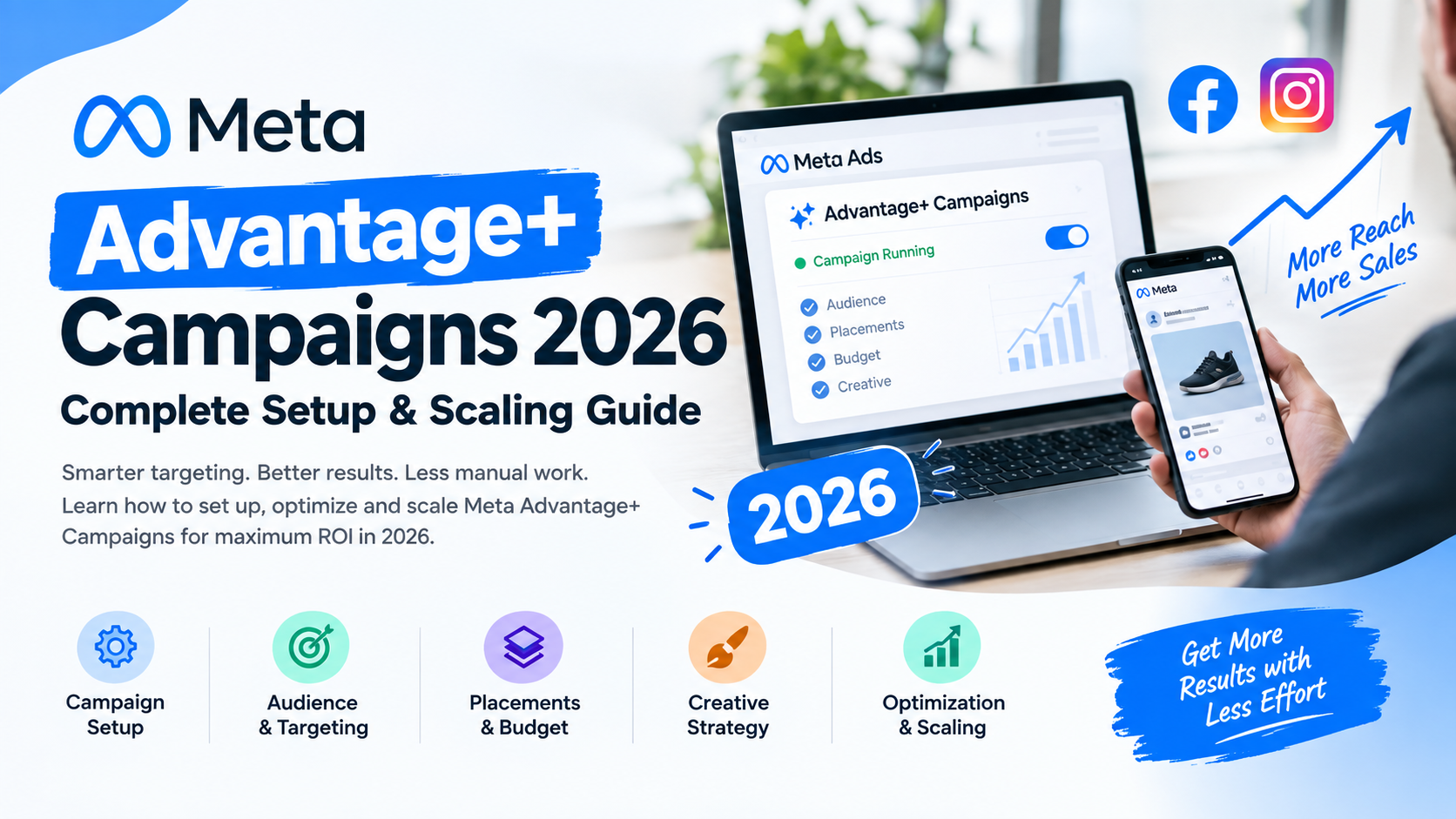
Advantage+ has quietly become the default way most serious ecommerce brands run Meta Ads in 2026. It’s not a shortcut that replaces strategy — it’s a different kind of campaign that needs its own setup logic, its own creative approach, and its own way of thinking about scaling. Brands that just turn it on and leave it alone usually get mediocre results. Brands that understand how to feed it properly tend to see it outperform manually structured campaigns by a wide margin.
This guide walks through setting up Advantage+ campaigns correctly, how to scale them without breaking performance, and where most ecommerce accounts still get it wrong.
What Advantage+ Campaigns Actually Are
Advantage+ shopping and sales campaigns hand most of the targeting, placement, and budget decisions over to Meta’s machine learning rather than relying on manually built audiences and ad sets. Instead of an advertiser guessing at interest groups or lookalike percentages, Meta’s algorithm searches across its entire user base for people likely to convert, using signals from the pixel, Conversions API, and catalog data.
The trade-off is control for performance. Advertisers give up granular audience targeting in exchange for an algorithm that’s often better than manual guesswork at finding buyers — provided it has enough data and creative to work with.
Setting Up an Advantage+ Campaign Correctly
- Get tracking right before anything else.Advantage+ leans heavily on pixel and Conversions API data to find buyers. If tracking is incomplete or inaccurate, the algorithm is optimising toward the wrong signals from day one. This is worth auditing before launching, not after performance disappoints.
- Clean up the product catalog.For ecommerce, Advantage+ pulls directly from the catalog feed. Accurate titles, pricing, availability, and image quality all affect how well the algorithm can match products to the right shoppers.
- Set a realistic starting budget.Advantage+ needs enough daily budget to exit the learning phase within a reasonable number of conversions, typically aiming for around 50 conversions per week per ad set as a rough benchmark. Underfunding it early usually just extends the learning phase.
- Load in creative diversity from day one.Unlike manual campaigns where a single strong ad can carry a campaign, Advantage+ performs best with multiple creative formats and angles loaded in together, since the algorithm tests combinations to find what resonates.
- Decide on audience suggestions carefully.Advantage+ still allows some audience input — existing customers, engaged users, or a small suggested audience. Use this to nudge the algorithm early rather than trying to fully control it, since over-restricting defeats the purpose of the campaign type.
- Let the learning phase run undisturbed.Meta needs a stretch of consistent activity to optimise. Frequent edits during this period — changing budget, swapping creative, adjusting settings — restart the learning phase and delay results.
Creative Best Practices for Advantage+
- Volume matters more than perfection — several decent ad variations usually outperform one perfectly polished ad, since the algorithm needs options to test.
- Mix formats — video, static images, and carousels together give the algorithm more combinations to work with across different placements.
- Keep refreshing — Advantage+ campaigns still fatigue on stale creative. A steady pipeline of new concepts, often supported by AI video creation, keeps performance from drifting down over time.
- Native-feeling content performs well — UGC-style and handheld video content tends to do well within Advantage+, similar to how it performs in manual campaigns.
Scaling Advantage+ Campaigns Without Breaking Them
Increase budget gradually
Sudden large budget jumps can push a campaign back into a learning phase, temporarily hurting efficiency. Incremental increases — commonly in the 20-30% range every few days — tend to preserve performance better than doubling budget overnight.
Let the algorithm consolidate, don’t fragment it
Running many small Advantage+ campaigns instead of fewer, better-funded ones usually works against the algorithm, since each campaign needs enough data independently to optimise well. Consolidating budget into fewer, well-resourced campaigns generally scales more efficiently.
Watch frequency and saturation
As budget scales, the same audience can start seeing ads too often, which drags down performance. Monitoring frequency and refreshing creative regularly helps offset this as spend increases.
Know when to add a second campaign instead of scaling one further
Every Advantage+ campaign has a ceiling on how much spend it can absorb efficiently within one audience pool. Once that ceiling is reached, testing a second campaign — sometimes targeting a different product category or customer segment — often scales further than pushing one campaign past its natural limit.
Common Mistakes with Advantage+ in 2026
- Editing constantly during the learning phase — restarts optimisation and delays stable results.
- Loading in too little creative — starting with just one or two ads limits what the algorithm has to work with.
- Ignoring catalog quality — a messy or incomplete product feed quietly caps performance regardless of ad spend.
- Treating it as fully automated and walking away — Advantage+ still needs monitoring, creative refreshes, and budget decisions; it reduces manual targeting work, not oversight.
- Expecting instant results at scale — a campaign that’s efficient at a smaller budget doesn’t always hold the same efficiency the moment spend triples overnight.
When Manual Campaigns Still Make Sense
Advantage+ isn’t the right fit for everything. Highly specific audience tests, brand-new product launches with very limited catalog data, or campaigns where precise audience exclusions matter (like separating existing customers from prospecting entirely) often still benefit from manually structured campaigns running alongside Advantage+, rather than replacing it completely.
How The Brand Hawk Runs Advantage+ Campaigns
At The Brand Hawk, Advantage+ setup starts with tracking and catalog audits before a campaign ever goes live, followed by a creative pipeline built for volume and variety — supported by AI video creation to keep new concepts flowing without constant reshoots. Budget scaling follows a controlled, incremental approach rather than aggressive jumps that risk resetting performance. When Advantage+ alone starts hitting its ceiling, we layer in Google Ads, TikTok Ads, or JioHotstar Ads to keep growth moving rather than pushing one campaign past its natural limit.
More on our approach is on the About Us page, and the full service list is at thebrandhawk.com.
Frequently Asked Questions
How long does the Advantage+ learning phase take?
It varies by account, but campaigns generally need to reach roughly 50 conversions within a week to exit the learning phase efficiently. Accounts with lower conversion volume can take longer to stabilise.
Can Advantage+ campaigns run alongside manual campaigns?
Yes, and for many ecommerce brands this combination works well — Advantage+ handling broad prospecting and catalog-driven ads, while manual campaigns handle specific retargeting segments or tightly controlled tests.
Why did my Advantage+ campaign’s ROAS drop after I increased budget?
Large, sudden budget increases often push a campaign back into a learning phase, which temporarily reduces efficiency. Smaller, incremental increases usually preserve performance better than one large jump.
Do Advantage+ campaigns need less creative than manual campaigns?
The opposite is generally true — Advantage+ tends to perform best with more creative variety, since the algorithm is testing combinations across formats and angles to find what resonates with different audience segments.