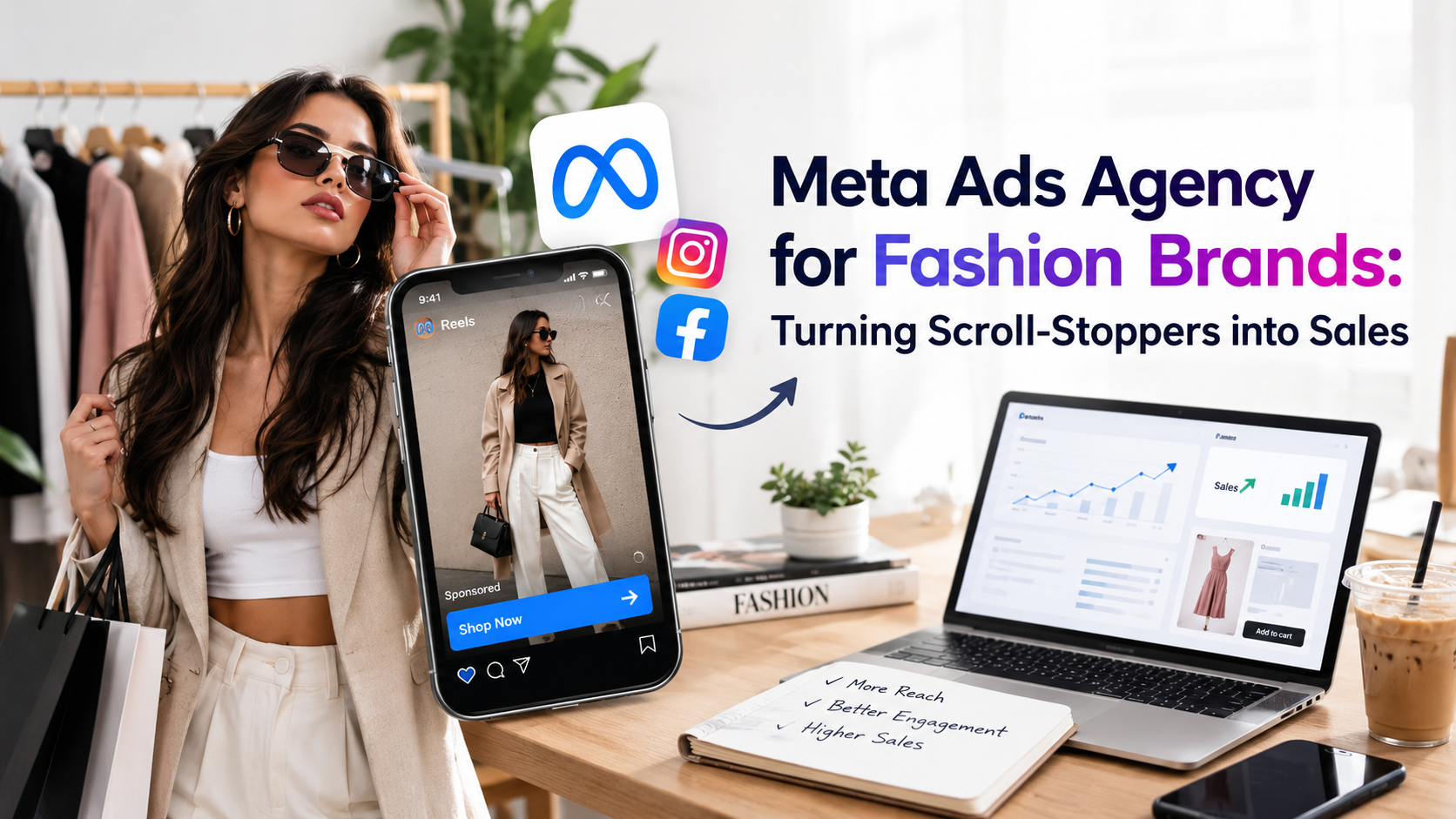
Fashion is one of the few ecommerce categories where the ad basically has to work as content first and a sales pitch second. Nobody stops scrolling for a product shot that looks like a catalog page. They stop for something that looks like it belongs in their feed — good styling, good movement, a hook that lands in the first second. That’s the real job of a Meta Ads agency working with fashion brands: turning scroll-stopping creative into a repeatable sales engine, not just a one-off viral moment.
This guide covers what actually makes fashion creative stop the scroll, how to structure Meta Ads around collections and drops, and where most clothing brands leave money on the table.
Why Fashion Brands Need a Different Meta Ads Approach
Fashion doesn’t behave like most other ecommerce categories on Meta. Trends move in weeks, not quarters. A huge part of the buying decision is visual and emotional rather than purely functional. And unlike, say, electronics or home goods, the same product can be styled a dozen different ways, giving fashion brands a genuine creative advantage — if the ad strategy actually uses it.
An agency running fashion ads the same way they’d run ads for a supplement brand or a kitchen gadget is missing most of what makes the category work. Fashion needs a creative-first strategy, with performance tracking built around it rather than the other way around.
What “Scroll-Stopping” Actually Means
It’s tempting to think scroll-stopping means flashy or loud. In practice, it’s more specific than that:
The first second does the work
On Reels and Stories, people decide whether to keep watching almost instantly. Fashion ads that perform usually open on movement, a strong visual, or an unexpected angle — not a logo or a slow product pan.
It looks native to the platform
Ads shot and edited like organic content — handheld movement, natural lighting, UGC-style pacing — consistently outperform polished studio shots on Meta, even for premium fashion brands. Polished has its place lower in the funnel; it rarely wins at the top.
Styling does the selling
Showing a garment on a rack tells someone what it is. Showing it styled, in motion, on a real body, tells someone what it could look like on them. That gap is where most of the conversion actually happens.
The hook matches the product’s real appeal
A hook about fabric quality works for a premium basics brand. A hook about a viral trend works for a fast-fashion drop. Matching the hook to why someone would actually buy that specific product matters more than chasing a generic “viral” format.
Structuring Meta Ads Around Collections and Drops
Fashion brands have a natural advantage most categories don’t: regular new product cycles. A good agency structures the account to take advantage of that instead of running the same evergreen campaign year-round.
- Dynamic catalog ads — for showing the right product to the right person based on what they’ve browsed, especially useful across a large SKU range.
- Drop-specific campaigns — dedicated creative and urgency-driven messaging around new collection launches, run separately from always-on evergreen campaigns.
- Style and outfit-based creative — ads built around a full look or occasion (festival wear, workwear, date night) rather than a single product in isolation.
- Seasonal retargeting — adjusting retargeting messaging as collections change, so someone who browsed summer wear isn’t seeing the same ad three months later.
Retargeting That Actually Fits Fashion Shopping Behaviour
Fashion shoppers browse differently than other ecommerce buyers — more back-and-forth, more comparing, more hesitation around size and fit. Retargeting needs to reflect that instead of just pushing the same “complete your purchase” ad to everyone.
- Browse abandonment ads that show the exact item styled a different way, not just the same product shot again.
- Size and fit reassurance for people who lingered on a size chart or product page without adding to cart.
- Cart abandonment ads timed around common hesitation points — shipping cost, return policy, or fit concerns.
- Cross-sell ads showing complementary pieces to past purchasers, since fashion has naturally high repeat-purchase potential.
Why Creative Volume Matters Even More in Fashion
Trend cycles move fast, and fashion audiences fatigue on repeated creative faster than most categories. Brands that keep performance stable are usually running a steady pipeline of new concepts — different styling, different models, different hooks — rather than one hero ad running for months. This is where AI video creation has become genuinely useful for fashion specifically, since it allows more creative variations without a new photoshoot for every single concept.
Pairing paid creative with consistent social media marketing also helps, since organic content often reveals which styling, models, or angles resonate before spending ad budget to test it at scale.
Common Mistakes Fashion Brands Make with Meta Ads
- Relying only on static product shots — video consistently outperforms static for fashion, especially on Reels placements.
- Running one ad per product forever — fashion needs restyling and refreshing far more often than most categories realise.
- Ignoring size and fit friction — a huge share of fashion cart abandonment comes down to fit uncertainty, not price.
- Treating every SKU the same in retargeting — a ₹500 basic tee and a ₹5,000 statement piece need very different retargeting messaging.
- Slow site experience undercutting good ads — fashion shoppers browse a lot of images and variants; a slow-loading product page kills momentum fast. Sometimes the fix is website development, not another ad tweak.
How The Brand Hawk Approaches Fashion Brands
At The Brand Hawk, fashion and clothing brands get a creative-first approach to Meta Ads — styling-led concepts, a steady content pipeline supported by AI video creation, and retargeting built around how fashion shoppers actually browse rather than a generic ecommerce funnel. We also run TikTok Ads and social media marketing alongside Meta, since fashion discovery rarely happens on just one platform, and website development when the site itself is the thing quietly capping conversions.
More on how we work with clothing and fashion brands specifically is on the About Us page, and the full service list is at thebrandhawk.com.
Frequently Asked Questions
How often should a fashion brand refresh its Meta Ads creative?
Many fashion brands see fatigue set in within 2-4 weeks per ad, faster than slower-moving categories. A steady monthly pipeline of new concepts, not just new products, keeps performance from dipping.
Do fashion brands need professional photoshoots for every ad?
Not necessarily. UGC-style and handheld content often outperforms polished studio shots on Meta, and tools like AI video creation can extend a single shoot into several ad variations without a new production every time.
Why do fashion brands see high cart abandonment even with good ads?
Size and fit uncertainty is one of the biggest drivers, along with shipping cost and return policy concerns. Retargeting that directly addresses these points usually recovers more of that lost revenue than generic “come back” messaging.
Is Instagram or Facebook better for fashion brand ads?
Instagram, especially Reels, tends to perform better for fashion given the visual, trend-driven nature of the platform, but Facebook placements often still contribute meaningfully to retargeting and a wider age range. Most fashion accounts run both together rather than picking one.