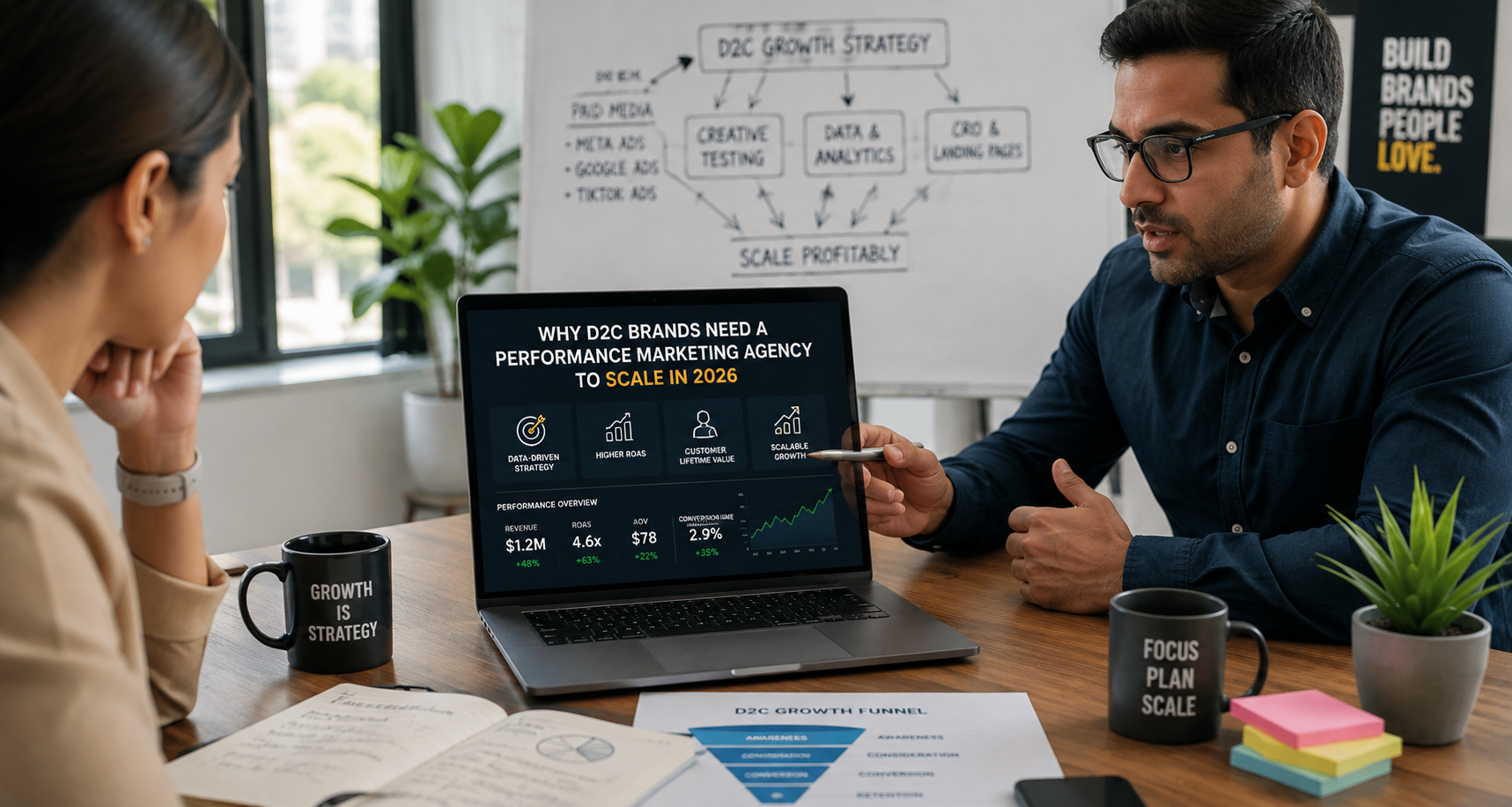
A few years ago, a D2C brand could get pretty far with a founder running ads part-time and a designer knocking out creative once a week. That’s not really true anymore. Between rising CPMs, tighter tracking rules, and more brands competing for the same attention, scaling past a certain point in 2026 usually means bringing in a performance marketing agency — not because founders can’t market, but because the work itself has gotten too specialised to run part-time.
Here’s what’s actually changed, and why it’s pushing more D2C brands toward dedicated agency partners this year.
What’s Different About Scaling D2C in 2026
Ad costs keep climbing
CPMs on Meta and Google have risen steadily as more brands compete for the same inventory. That means weak creative and loose targeting get punished faster than they did two or three years ago — there’s less room for an inefficient campaign to still turn a profit.
Tracking is harder to get right
Privacy changes since iOS14 have made accurate attribution genuinely technical. Conversions API, server-side tracking, and data reconciliation aren’t optional extras anymore — without them, a brand is often optimising toward the wrong numbers without knowing it.
Customers expect to discover brands differently
Shoppers now move between Instagram Reels, TikTok, YouTube Shorts, and streaming platforms before ever landing on a product page. A brand only running one Meta Ads campaign is leaving a lot of that discovery surface untouched.
Creative volume matters more than ever
What used to work for months now fatigues in weeks. Brands that scale in 2026 are the ones pushing a steady stream of new creative, often supported by AI video creation to keep volume up without the cost of constant traditional shoots.
Why a Founder Running Ads Solo Hits a Ceiling
This isn’t about founders lacking skill — most early D2C growth actually comes from founders who understand their product and audience better than anyone else could. The ceiling shows up for structural reasons:
What a Performance Marketing Agency Adds at Scale
Multi-channel coverage
Instead of leaning on one platform, an agency typically spreads spend across Meta Ads, Google Ads, TikTok Ads, and increasingly JioHotstar Ads for large-scale reach in India — so one platform’s slowdown doesn’t stall the whole brand’s growth.
A real creative testing system
Rather than one ad running until it dies, agencies typically run several concepts at once, track which angles perform, and keep a pipeline of new creative ready before fatigue sets in.
Accurate tracking and forecasting
With clean data, an agency can tell a brand roughly what to expect from a given spend level — turning growth from a guess into something closer to a plan.
Full-funnel strategy, not just prospecting
Retargeting, retention, and consistent social media marketing keep existing customers coming back, which matters more as acquisition costs rise — repeat revenue is usually the cheapest revenue a brand has.
Catching non-ad bottlenecks
Sometimes the real ceiling isn’t the ads at all — it’s a slow site or a confusing checkout. A good agency flags when website development work would unlock more growth than another rupee of ad spend.
Signs Your D2C Brand Has Outgrown Solo or Freelance Management
What to Look for in a Performance Marketing Partner
Not every agency is built for D2C specifically. A few things worth checking before committing:
- D2C-specific results — ask for real examples of CAC and revenue changes over time, not just screenshots.
- A defined creative process — how many new concepts they test monthly, and whether that includes video.
- Clear tracking practices — they should be able to explain server-side tracking and attribution simply.
- Multi-channel capability — so the brand isn’t stuck restarting the vetting process when it’s time to add a new platform.
- Transparent reporting — tied to revenue and CAC, on a consistent schedule.
How The Brand Hawk Helps D2C Brands Scale
At The Brand Hawk, scaling a D2C brand in 2026 means building the same kind of system described above: multi-channel coverage across Meta Ads, Google Ads, TikTok Ads, LinkedIn Ads, and JioHotstar Ads, a steady AI video creative pipeline, tracking set up correctly from day one, and website development support when the site — not the ads — turns out to be the real bottleneck.
More on our approach is on the About Us page, and the full service list is at thebrandhawk.com.
Frequently Asked Questions
At what revenue stage should a D2C brand hire a performance marketing agency?
There’s no fixed number, but many brands start once they’re spending enough monthly on ads that managing it well requires more than a few hours a week, or once growth has plateaued despite steady effort.
Is a performance marketing agency only useful for scaling, or also for new D2C brands?
Both. Newer brands benefit from getting tracking and channel strategy set up correctly from the start, which avoids costly rework later once spend increases.
How is a performance marketing agency different from a general digital marketing agency for D2C?
Performance marketing agencies focus specifically on measurable outcomes — CAC, ROAS, revenue — rather than broader brand or engagement goals, which matters more as a D2C brand’s margins tighten with scale.
What’s a realistic timeline to see scaling results after hiring an agency?
Most brands see initial testing and setup in the first month, with clearer scaling trends emerging from month two or three onward as the account gathers enough data to optimise properly.